Chapter 1: Welcome to New Jersey's Billboard Business
IN THIS CHAPTER
» Discovering the two-track system every billboard deal follows
» Meeting the two people whose shoes you'll walk in through this book
» Understanding why New Jersey treats billboards differently than most signs
» Getting oriented before you spend a dollar
Maria Chen has owned a vacant corner lot off Route 1 in Edison for six years, mostly as a placeholder while she figured out what to do with it. Then a billboard company called with an offer to lease the land, and she realized she had no idea whether the number they quoted was generous or insulting, or whether the whole thing was even legal on her property. That phone call is where this book actually begins, not with statutes or forms, but with someone standing in a parking lot wondering what she just agreed to think about.
This chapter gets you oriented before you sign, pay, or promise anything. You'll meet the two tracks every billboard deal runs on, meet the two people whose situations you'll follow through the rest of the book, and understand why New Jersey makes this harder than slapping a sign on a fence.
The Two-Track System: Land and Law
Every legal billboard in New Jersey exists because two separate things happened at once: someone secured the land, and someone secured the paperwork. Miss either track and you don't have a billboard. You have a very expensive lawn ornament facing a lawsuit.
The land track means getting rights to the physical spot where the sign will stand. That usually takes the form of a ground lease, a rental agreement where a landowner gets paid for letting someone else's structure sit on their property, or an easement, a narrower right to use a strip of land for a specific purpose without transferring any broader use of it. Maria is on this track. She owns the dirt, and the question in front of her is what kind of deal to make and with whom.
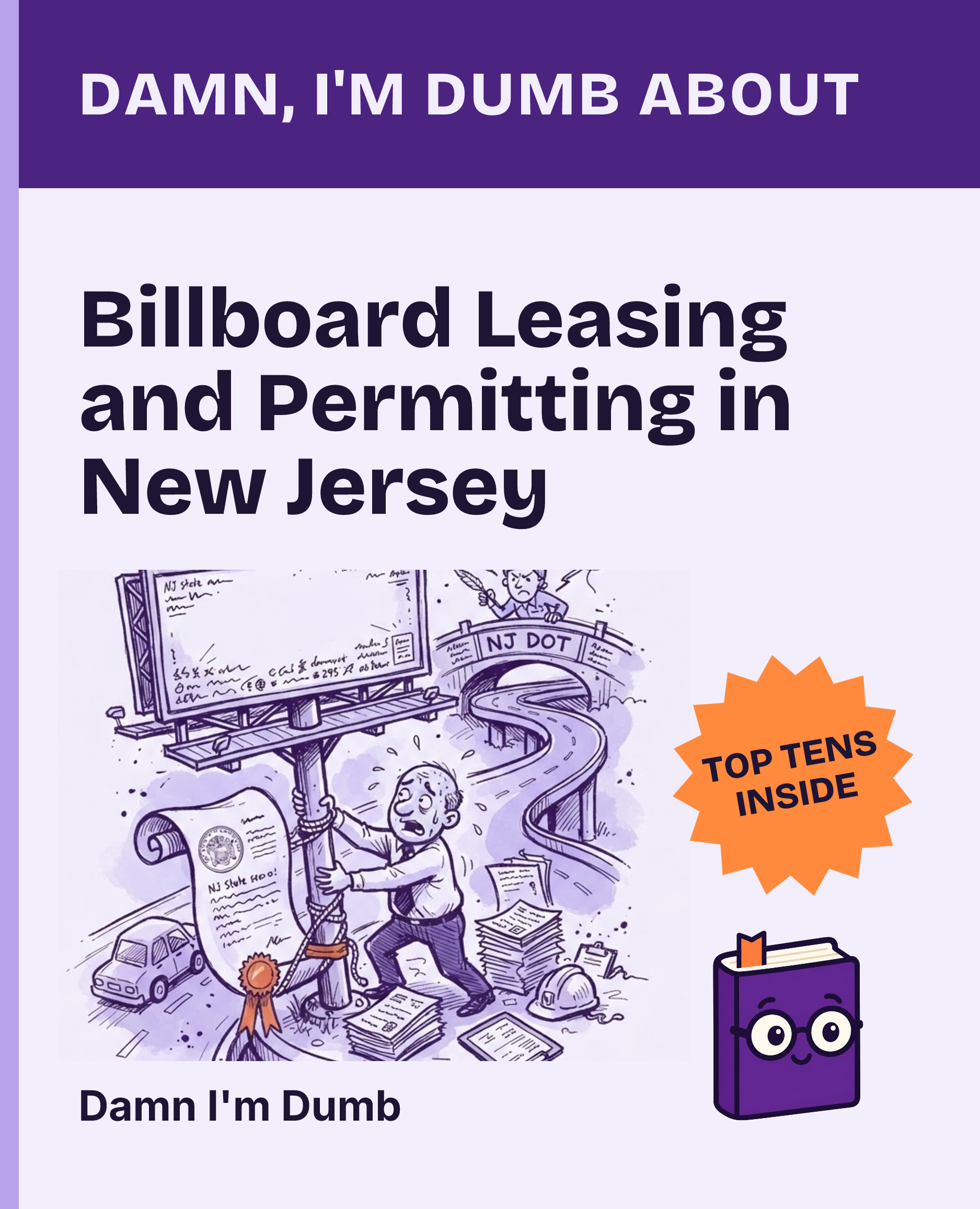
The law track means getting permission from every government body with a say in the matter. In New Jersey that starts with the state, specifically the New Jersey Department of Transportation's Office of Outdoor Advertising Services, which you'll see referred to as OOAS throughout this book. It also includes your municipality's zoning and building departments, and sometimes a federal layer tied to interstate highways. Dan Okafor is deep in this track right now, trying to get his new company licensed before he even has a specific sign to put up.
Here's the part that trips people up constantly: these two tracks don't wait for each other politely. You can have a landowner ready to sign and a buyer ready to pay, and still be months away from a legal sign because the state permit hasn't cleared. You can also have every state approval lined up and discover your town's zoning board has never heard of your project and wants a public hearing first. Chapter 3 maps out exactly how these layers stack, but for now, just hold onto the idea that land and law move on separate clocks, and your job is to keep both clocks ticking at the same time.
DON'T FORGET: A signed lease is not a permit, and a permit is not a lease. You need both, and neither one guarantees the other is coming.
Meet Maria and Dan: Two Ways Into This Business
Most people enter the billboard business from one of two directions, and you're probably standing on one side or the other right now. Maria represents the landowner path: she didn't go looking for this, the opportunity came looking for her, in the form of a lease offer on land she already owned. Her corner lot off Route 1 gets steady traffic, which is exactly the kind of location that makes a billboard company pick up the phone.
Dan represents the operator path. He spent years managing a sign shop, learned the business from the inside, and decided to start his own outdoor advertising company under the name Garden State Outdoor. Unlike Maria, Dan doesn't own land yet. His first job is getting his company licensed with the state before he can legally pursue any sign at all, which means his early chapters look very different from hers even though they're both trying to get a billboard standing legally.
If you're more like Maria, someone approached you, or you're sitting on land and wondering if it could earn more than it currently does, you'll get the most immediate value from Chapter 7 on lease structures and Chapter 8 on negotiating the ground lease itself. If you're more like Dan, building a business from scratch and planning to pursue sites and licenses proactively, Chapter 4 on getting licensed and Chapter 5 on the permit process will matter to you sooner.
Plenty of readers are a blend of both, maybe a property owner who likes the idea of starting a small outdoor advertising company instead of just leasing to someone else's. That's fine. Maria and Dan will show up throughout this book precisely because their situations overlap more than they first appear to, and watching both tracks side by side will save you from assuming your path is simpler than it actually is.
SMART MOVE: Figure out which side of the deal you're really on before your first phone call. A landowner who sounds like they're pitching themselves as an operator, or vice versa, loses credibility fast with people who do this for a living.
Why New Jersey Plays by Stricter Rules
New Jersey didn't back into its billboard regulations by accident. The state passed the Roadside Sign Control and Outdoor Advertising Act in 1991, a law that put a single state office in charge of licensing outdoor advertising companies and permitting individual signs across the entire state, rather than leaving the whole thing to a patchwork of local rules.
That office is OOAS, short for the Office of Outdoor Advertising Services, and it sits inside NJDOT. OOAS is responsible for overseeing permits for outdoor advertising signs along the state's roads and highways, checking that new signs meet safety standards and don't create the kind of visual chaos that makes a highway harder to navigate. If you want to put up an off-premise sign, meaning a sign that advertises a business not located on the same property as the sign, OOAS is the state agency standing between you and a legal structure.
This matters for a very practical reason: locations are genuinely scarce. Spacing rules, zoning restrictions, and the sheer density of New Jersey's road network mean there are only so many legal spots left for new signs, which is part of why existing billboard locations can be valuable even when the structure on them looks unremarkable. You're not just asking for permission to build something. You're competing for one of a limited number of legal positions on the map.
SIDEBAR: Why Billboards Need Their Own Law
Before 1991, New Jersey handled outdoor advertising the way most states did, through a mix of local ordinances and whatever general sign rules a municipality happened to have on the books. That patchwork made it hard to enforce consistent safety and spacing standards across a small, densely built state with a lot of highway frontage. The Roadside Sign Control and Outdoor Advertising Act centralized licensing and permitting under one state office, OOAS, while still leaving local zoning and building approval in place. The result is the two-layer system you're learning in this book: one state process for the sign and its operator, and one local process for the property and its zoning, running at the same time rather than one replacing the other.
NERD ALERT: The 1991 state law overlaps with a federal law from 1965, the Highway Beautification Act, for any sign near an interstate highway. Chapter 3 untangles how those two laws interact without you needing to read either one cover to cover.
What This Book Will and Won't Do For You
This book will teach you how the system works, what each approval actually requires, and how to avoid the mistakes that waste the most time and money. It walks through licensing, permitting, zoning, lease structures, and the content rules that govern what a sign can actually say, all pitched at someone who has never done any of this before.
What this book won't do is replace a real estate attorney or your municipal planning department, and I want to be upfront about that now rather than let you discover it the hard way later. Lease agreements involve liability and indemnification language that needs a lawyer's eyes before you sign anything (Chapter 8 goes into why). Zoning requirements vary enough from one municipality to the next that no book, including this one, can tell you exactly what your specific town requires.
Think of this book as your briefing before the meeting, not the meeting itself. You'll walk in knowing the right questions to ask and the vocabulary to use, which saves money because professionals charge less to answer informed questions than to explain basics from scratch.
DON'T FORGET: Treat your real estate attorney and your municipal planning office as required reading partners for this book, not optional extras you'll get to eventually. Every chapter that touches a lease or a local approval will remind you when it's time to make that call.
Your First Quick Win: Mapping Your Own Starting Point
You can do this in fifteen minutes, and it's the single most useful thing you can do before reading another page. The goal is simple: figure out which path you're on, landowner or operator, and identify the first three people you need to call.
Start by being honest about your situation rather than the situation you wish you had. Own property and fielding an approach from a billboard company? You're on the landowner path like Maria. Building a company to pursue sites, licenses, and permits as a business? You're on the operator path like Dan. Both at once? That's a legitimate third category.
Work through these steps:
- Write down your path in one sentence. For example, "I own a corner lot and a company wants to lease it," or "I'm starting an outdoor advertising company and need my first license." This sentence becomes your filter for which chapters to prioritize.
- List your first three calls. Landowners often call the company that approached them, the municipal zoning office, and a real estate attorney. Operators call OOAS, a licensed surveyor, and an attorney familiar with outdoor advertising.
- Write what you don't know next to each call. List the gaps, not answers; that list shows which chapters matter most right now.
- Set a date for your first call. Plan to make it "sometime soon" and it won't happen. Schedule it for Thursday afternoon and it will.
Maria's version of this exercise looked straightforward on paper: landowner path, calls to the billboard company's representative, Edison's zoning office, and a real estate attorney, with "what's a fair rent structure" written next to the first call and "is my lot even zoned for this" next to the second. Dan's list looked different, with OOAS, a surveyor, and an attorney specializing in outdoor advertising licensing, and "do I need a surety bond since I'm just starting out" written next to all three.
Neither list required any special knowledge to create. It required fifteen minutes and a willingness to write down what you don't yet know, which is a more useful skill in this business than most people expect going in.
Chapter 2 picks up right where this exercise leaves off, helping you figure out whether a specific site, land you own or land you're eyeing for a sign, is actually worth pursuing before you invest more time in it.